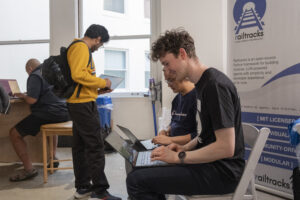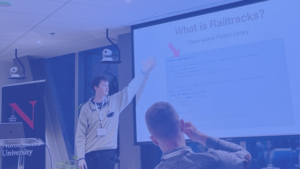
The buzz of innovation filled the Edmonton Convention Centre as AI practitioners, researchers, and enthusiasts gathered for Upper Bound 2026, Canada’s premier AI conference. From May 19-22, attendees explored the cutting edge of artificial intelligence through keynotes, technical sessions, and immersive workshops. But among the many highlights, one workshop stood out for turning abstract AI concepts into tangible, competitive fun: Railtracks’ “Hop on the Agents’ Wagon.”
Upper Bound: Where AI Theory Meets Practice
Upper Bound has established itself as the go-to conference for anyone serious about AI development and deployment. This year’s edition brought together machine learning engineers, data scientists, product leaders, and entrepreneurs to explore everything from foundational models to production deployment strategies. The conference’s blend of technical depth and practical application made it the perfect venue for Railtracks to showcase what agentic AI can really do.
“The next wave of AI applications demands more than API calls; it requires agentic systems that can reason, plan, and act within complex environments,” is the conference’s promise. This wasn’t just another lecture about AI theory, it was a hands-on dive into building agents that could actually do something.
Logan Underwood, Machine Learning Engineer at RailtownAI, led the three-hour intermediate-level workshop that transformed attendees from passive learners into active builders. The session promised to cover the full lifecycle of agentic systems, and it delivered.
Here’s where things got interesting. Rather than simply watching slides about how agents work, participants immediately got their hands dirty building their own AI agents using the Railtracks framework. The twist? Their agents would run locally compete in real-time on a live leaderboard.
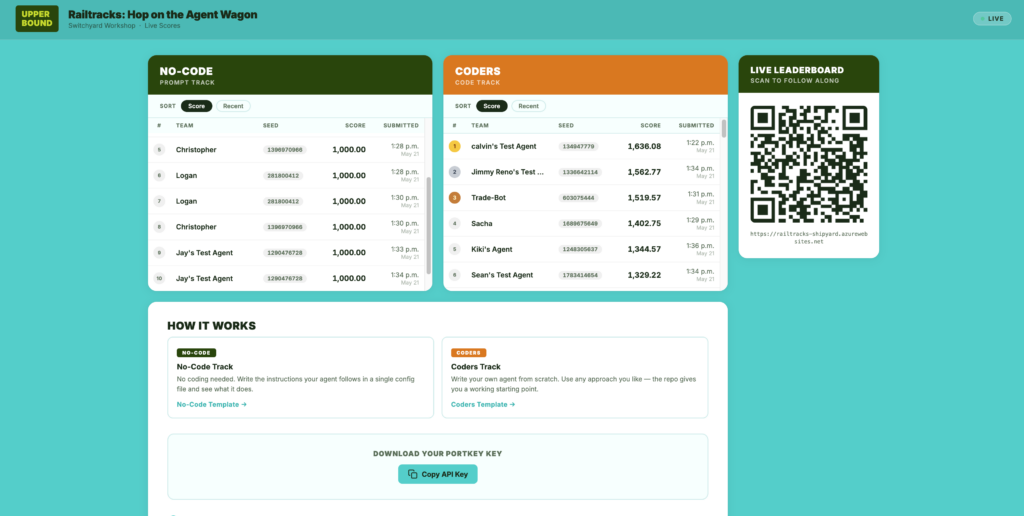
The workshop featured two tracks catering to different skill levels:
No-Code Track (Prompt Track): Perfect for those new to agent development, this track required no coding experience. Participants simply wrote instructions in a configuration file and watched their agents come to life. It was AI democratization in action, a proof that you don’t need to be a developer to build intelligent systems.
Coders’ Track (Code Track): For the more technically inclined, this track offered complete freedom. Participants could write their agents from scratch using any approach they preferred, with the Railtracks repository providing a working starting point.
As agents ran through the simulated environment, scores populated in real-time on a stunning leaderboard interface. The competitive element transformed learning into a literal game. Participants battled it out, their scores updating live as their local agents navigated challenges, made decisions, and executed tasks.
Real Impact, Real Learning
For many attendees, the Railtracks workshop became the highlight of their Upper Bound experience. After days of attending sessions at the Edmonton Convention Centre, the immersive nature of this workshop stood out. The simulated trading environment using Python-based AI agents gamified the experience of working with autonomous systems, showing participants firsthand how agents can influence decision-making and drive real results.
The hands-on format made all the difference. Instead of only hearing about AI concepts through slides and theory, attendees could test them, experiment with them, and see the outcomes in real time. That kind of active learning transformed abstract ideas into practical, memorable experiences. Several participants expressed wishes that they’d attended more immersive workshops throughout the conference, with plans to bring their laptops every day next year to take full advantage of these learning opportunities.
This is the power of experiential learning. By combining theoretical knowledge with immediate application and competitive feedback, the workshop transformed abstract concepts into muscle memory. Participants didn’t just learn about agentic AI, they experienced what it feels like to build, deploy, debug, and optimize autonomous systems.
Key Takeaways for Attendees
By the end of the session, participants walked away with practical skills they could apply immediately:
- Design agentic workflows for a variety of tasks, from simple automation to complex decision-making
- Implement agents using the Railtracks framework with hands-on code examples
- Iterate effectively using local Railtracks tooling for rapid development cycles
- Monitor agents with Railtrack’s Agent Observability and Evaluation for continuous monitoring, usage flow analysis, and iterative improvement
But perhaps most importantly, they left with proof that agentic AI isn’t some distant future technology, it’s ready to use today, accessible to both coders and non-coders alike.
Why Agentic AI Matters
The workshop’s core message resonated throughout: whether you’re designing research prototypes or building production-grade AI systems, Railtracks provides the technical depth and architectural insights to move from simple API calls to truly agentic software. This represents a fundamental shift in how we think about AI applications.
Traditional AI tools wait for instructions and return responses. Agentic AI takes initiative, makes plans, and acts autonomously to achieve goals. It’s the difference between a calculator and a colleague and the Railtracks framework makes this level of sophistication accessible to developers at any level.